
News
A village gets to work: Steinbach has shouldered Mahler's symphony
It rarely happens that there are more people on stage at a classical concert than the town where the performance is taking place has inhabitants.
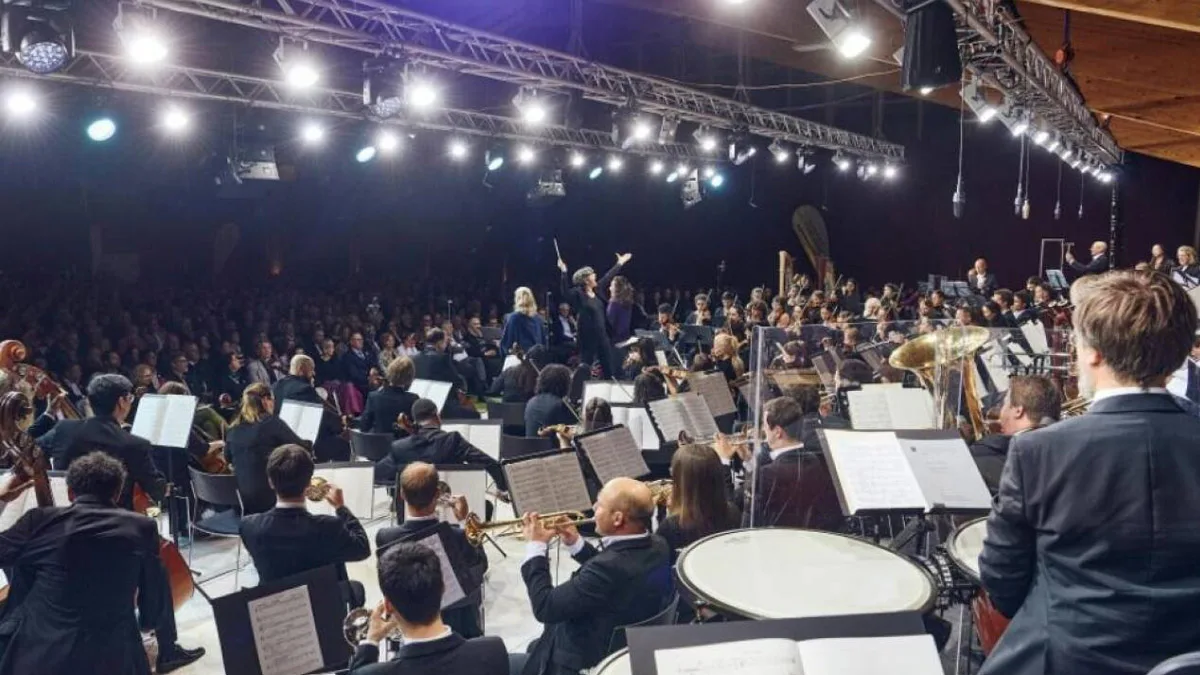
It rarely happens that there are more people on stage at a classical concert than the town where the performance is taking place has inhabitants. And even in the small town of Steinbach am Attersee with 900 inhabitants, this was hardly the case on Saturday evening, even though around 200 musicians and singers were involved in Gustav Mahler's 2nd Symphony. The Gustav Mahler Festival, which has been running since 2016, dared to pull off an unprecedented feat this year and included the monumental work in the programme.
The local sports hall was quickly converted into a music hall using sound-optimising elements, while practically the entire town worked together to make the large-scale project a success. After all, this year's event is being organised under two major cultural umbrellas: it is part of the current European Capital of Culture Year Salzkammergut and celebrates the current Bruckner Year to mark the 200th birthday of the great Upper Austrian composer.
Since the opening on Thursday, several lectures and walks have been dedicated to the relationship between the two highly romantic composers Mahler and Bruckner, who were on friendly terms with each other and yet repeatedly took a critical look at each other's work. The first documented evidence of this relationship dates back to 1880, when Bruckner commissioned the young Mahler to prepare the piano version of his 3rd Symphony. The monumental pianistic work for four hands was on the programme of the festival curated by artistic director Morten Solvik on Sunday morning.
However, the highlight of the 2024 edition was undoubtedly the performance of Mahler's 2nd Symphony, which was attended by Culture Minister Werner Kogler (Greens) and Capital of Culture Director Elisabeth Schweeger in order to trace the genius loci. The three middle movements of the symphony, for example, were once composed in the composer's cottage in Steinbach, which is still moving in its simplicity and which Mahler used for four summers from 1894. The first movement and parts of the final movement, however, were written elsewhere. It may come as no surprise that the long ‘Totenfeier’ (Celebration of the Dead), the prelude to the work often referred to as the ‘Resurrection Symphony’, does not originate from the lovely idyll of Lake Attersee.
The fact that the style of the subsequent movements, clearly inspired by the Salzkammergut region, was emphasised on Saturday is thanks to conductor Elisabeth Fuchs and her Philharmonie Salzburg, which was engaged as a top orchestra for this daring undertaking. The Maestra takes some tempo changes quite rapidly and plays out the country dances and folk tunes almost teasingly, which other conductors often try to shamefully conceal. ‘I am a child of brass music,’ the 48-year-old Upper Austrian made clear in the APA interview. And even if Mahler himself was not such a child, he adopted these sounds during his summer holidays. ‘You can hear the humour,’ Fuchs is convinced.
It would have taken a lot of humour if Fuchs' original idea of performing the monumental symphony in the open air had been realised, as torrential rain poured over Steinbach on Saturday. In the converted sports hall, however, the acoustics were dry, while outside the torrents ravaged Steinbach. But, unlike sometimes in the Salzburg Festspielhaus, the ceiling withstood the rain, and the nature mystic Mahler would probably have liked the gentle splashing on the roof anyway.
As not only Mahler and Bruckner are revered as musical patron spirits in Steinbach, but also Friedrich Gulda, who lived for decades on Lake Attersee and is buried in Steinbach, the evening began with the cello concerto by the master of musical interweaving. Gulda's work is a decided homage to the region, blending jazz, classical music and what Mahler would have called ‘Landler’. Wind orchestra and band, E and U go hand in hand here with the cello, on which the 14-year-old Emilian Schmid sat before he was ultimately replaced by his brother Darius, two years his senior, on the violin and switched to percussion.
So Mahler is not everything in Steinbach, even if the composer undoubtedly plays first fiddle in Steinbach. In addition to the composer's house as a place of remembrance, there is also the Gustav Mahler diptych by Christian Ludwig Attersee in the village centre building, inaugurated in 2012, as well as a memorial stone on the landing stage. And on Lake Attersee itself, the MS Stadt Vöcklabruck, which has also recently been dedicated to Gustav Mahler, is now underway. The ship was redesigned in co-operation with the Capital of Culture. The foundations have therefore been laid for the fledgling festival in Steinbach to continue to hold its own in the summer festival circuit.